
Looking for a Letterboxd for video games? That’s a different question, and we answered it here: Letterboxd for Games? We Tested 7. Here’s the One. This page is for the board game side. You rate every film on Letterboxd and log every book on Goodreads, but if Wingspan is your Saturday and Elden Ring is your Sunday, you’re stuck running two separate apps. Until recently that was just how it worked. Here is where tabletop tracking stands in 2026, and why the answer has changed.
The video game trackers that skip board games
The most common answers when people search for a Letterboxd for games are Backloggd, GG, and HowLongToBeat. All three are solid for video games. None of them track board games.
Backloggd pulls from the IGDB database, which is video game only. You can’t add Ticket to Ride or Spirit Island. No tabletop support, no plans to add it.
GG is the same. Video games, clean design, no board game catalog.
HowLongToBeat is a utility for completion times. Video games only, no community or collection features beyond that.
BoardGameGeek goes the other direction: it’s the definitive board game database and community, but it has no video game support. If you’re logging Gloomhaven sessions and Call of Duty sessions, BGG covers exactly half of your hobby.
The one that does
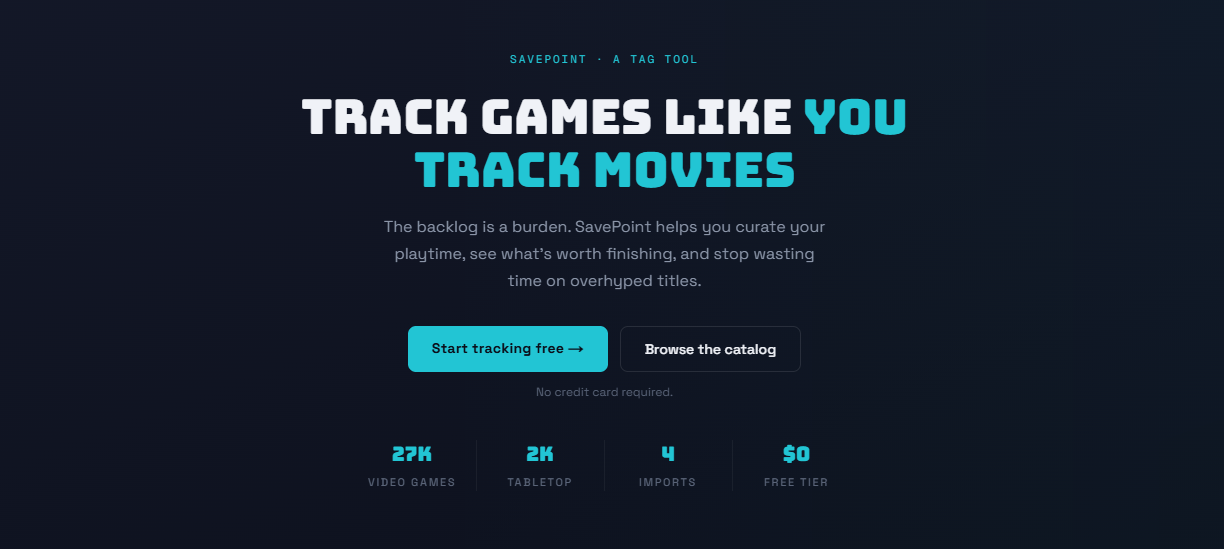
SavePoint is built specifically to cover both. The catalog has 35,000+ games: around 33,000 video games and 2,000 tabletop titles, all in a single library. Steam, Xbox, and PSN imports are all here too, gated to the Pro tier. BGG import is free for anyone.
That matters more than it sounds. Most people who play board games also play video games. Having two separate tracking systems means one of them doesn’t get updated. The one that doesn’t get updated is usually the board games, because logging on BGG is more work than logging on a dedicated tracker.
SavePoint’s import from BGG means your collection comes over automatically. New ratings, plays, and acquisitions from BGG stay in sync.
What SavePoint does beyond logging
The library is the core, but two features are worth calling out for anyone with a backlog in both formats.
Backlog Score adds up the dollar value of every game in your library you haven’t started yet. For most people with a Steam library and a shelf of unplayed board games, this number is somewhere between uncomfortable and genuinely alarming. It’s a useful way to think about what to prioritize.
Decision Engine gives you three picks for tonight based on your mood, how much time you have, and what platform you’re playing on. It pulls from the full library, including board games, so if you’ve got two hours and four players available, it will surface the right game from your shelf.
The honest tradeoffs
SavePoint’s tabletop catalog is smaller than BGG’s. BGG has over 100,000 board games cataloged. SavePoint’s 2,000 tabletop titles covers the mainstream and popular games well, but if you play obscure wargames or very niche titles, you may hit gaps.
The video game side has no such limitation. Approximately 27,000 titles covers the full commercial library including indie games.
SavePoint is also newer than BGG and has a smaller community. If reading session reports and finding opponents for your specific game are important to you, BGG is still the place for that. SavePoint is not trying to replace BGG’s community. It’s trying to replace the spreadsheet you use to track what you own.
Who this is for
If you play board games occasionally alongside your regular video game time, SavePoint is the easiest way to have one place for all of it. The free tier covers the full library and both imports.
If board games are the primary hobby and community is important, you probably still want BGG for the social side. You can use both: BGG for community, SavePoint for the unified library view.
If you’re only tracking video games, any of the main options will serve you. Backloggd is the default recommendation for a reason.
Try SavePoint free at savepoint.twoaveragegamers.com. No credit card required. The full library and Backlog Score are free. Steam, Xbox, and PSN auto-sync imports are Pro ($9/month or $99/year, or $149 once for a lifetime Founding seat while those last). BGG import is free for anyone, and you can also bring an existing Backloggd library over with a one-time CSV import on the free tier.
📌 Save Letterboxd for Board Games: The One App That Logs Wingspan and Elden Ring to your backlog
Track every game you play, rate what's worth finishing, skip the overhyped ones.