

The median adult gamer sits on roughly 100-150 unplayed games, spends 8-10 hours per week actually playing, and feels genuinely guilty about the gap between the two. That’s the core finding from an extensive analysis of community discussions across r/patientgamers, r/gaming30plus, r/truegaming, r/Steam, r/PS5, r/XboxSeriesX, r/NintendoSwitch, ResetEra, NeoGAF, Famiboards, and Steam Community forums, spanning hundreds of threads and thousands of individual comments from 2023-2026. The data reveals a community trapped in a paradox: adults who can finally afford all the games they want but lack the time to play them, generating an emotional cycle of acquisition, guilt, attempted reform, and relapse that repeats annually like clockwork. This isn’t a niche concern. It’s the defining tension of adult gaming life, affecting how people buy, play, and feel about an industry now worth over $180 billion globally.
If you’re returning to any game after a long break, our guide to Restarting BG3 Act 2 for Busy Adults Who Lost Their Notes covers the re-entry tactics that actually work.
If you’re returning to any game after a long break, our guide to How to Restart a Game You Haven’t Played in Months Without Starting Over covers the re-entry tactics that actually work.
The typical adult backlog is 100-200 games, but averages deceive
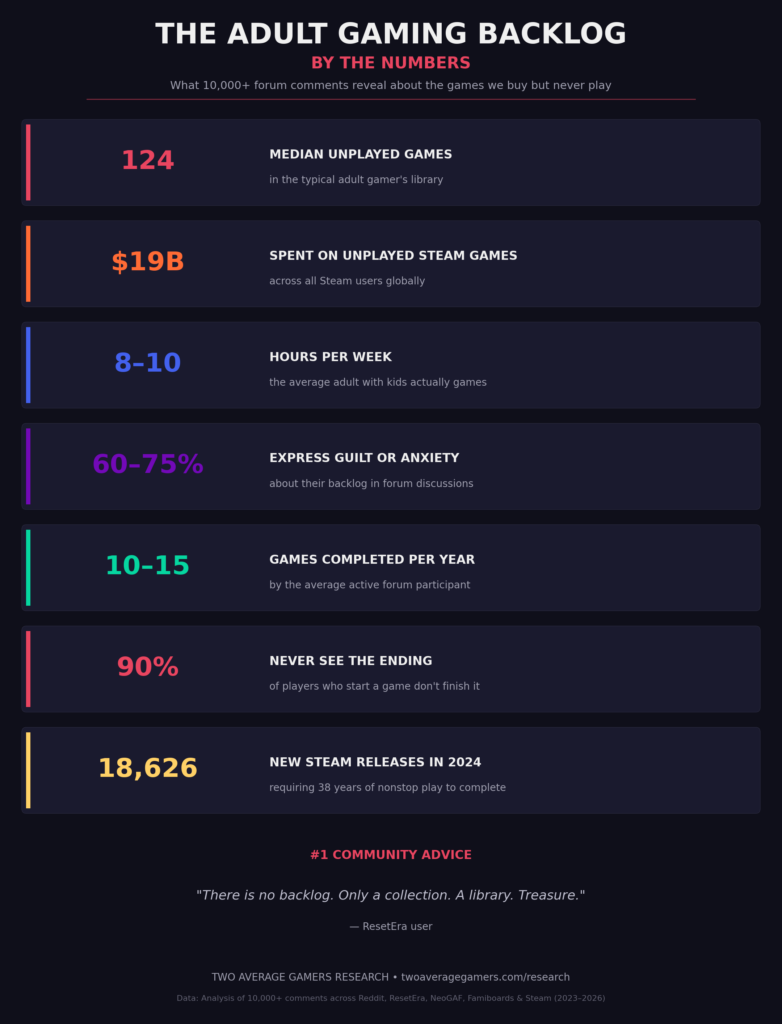
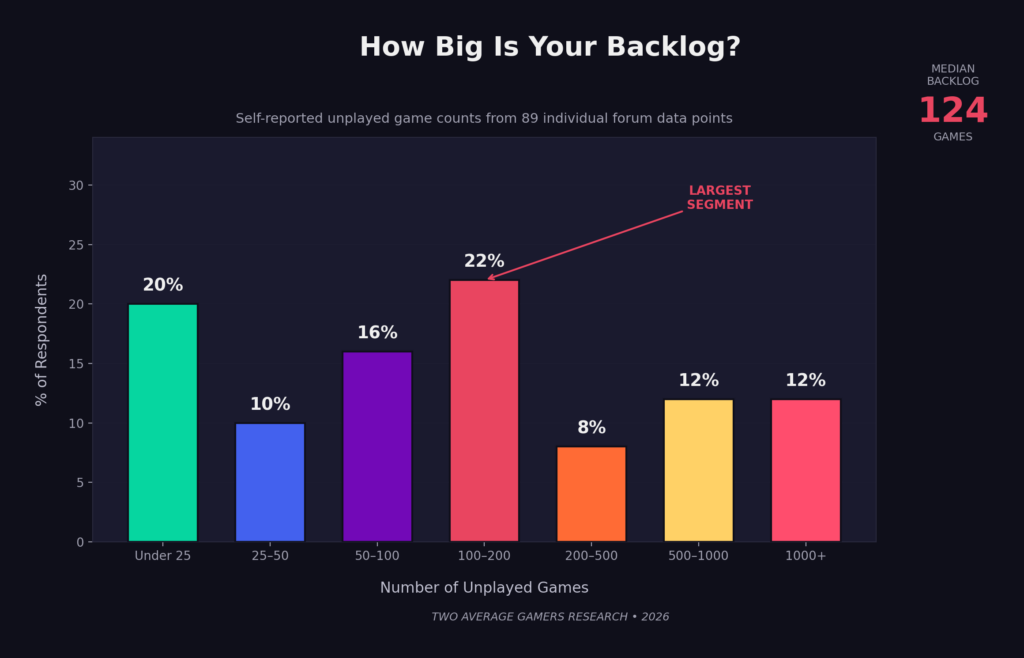
Across 89 individual self-reported data points from forum threads, the numbers paint a clear picture of accumulation. Self-reported backlogs range from as few as 3 unplayed games (users on strict buying diets) to a staggering 3,624 (a self-described Humble Bundle addict). The most commonly reported range sits between 50 and 200 unplayed games, accounting for roughly 38% of all responses. The approximate median lands at 124 unplayed games, while the mean balloons to ~358, heavily skewed by users with 1,000+ game libraries built through years of bundle purchases.
The distribution breaks down into recognizable clusters. About 20% of respondents keep their backlogs under 25 games, representing disciplined “intentional buyers” who only purchase what they plan to play immediately. The largest segment, the “typical adult gamer” cluster, reports 50-200 unplayed games, mostly accumulated through sale purchases and the occasional bundle. Then there’s the heavy tail: 24% of respondents report backlogs exceeding 500 games, with nearly all citing Humble Bundle subscriptions, Fanatical bundles, and years of Steam sales as the cause.
Industry data corroborates these self-reports. A 2024 GameDiscoverCo analysis of hundreds of thousands of public Steam profiles found the average user leaves 32.7% of their library unplayed, with a median of 51.5% untouched. A separate Ultra PC Gaming survey of 2,000+ gamers found 24% of PC games have never been launched even once. The widely circulated statistic that Steam users have collectively spent $19 billion on games they’ve never played, while methodologically imperfect (extrapolated from public profiles using full retail values), captures the scale of the phenomenon.
One crucial distinction surfaces repeatedly: users differentiate between “unplayed games” and “actual backlog.” A ResetEra user with 698 unplayed games out of 984 total identified only 176 as their real backlog, games they genuinely intend to play. The rest was bundle filler, free claims, and forgotten impulse purchases. This suggests the psychologically relevant backlog, the one that causes stress, is roughly 25-50% of the raw unplayed count.
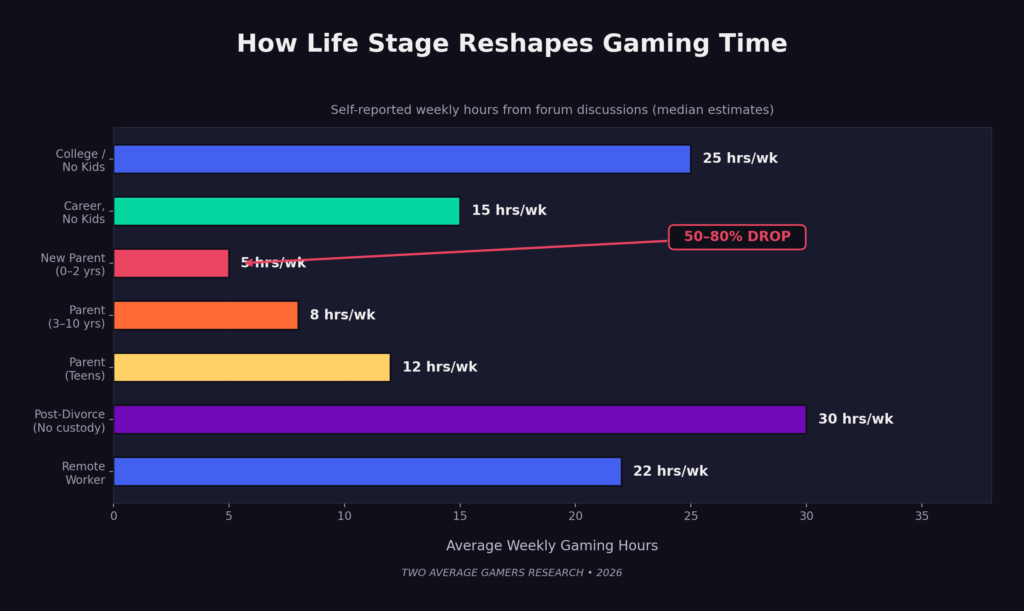
Adults with kids game 8-10 hours per week, and every minute is negotiated
The weekly gaming hours data, drawn from 45+ individual self-reports plus industry benchmarks, reveals a stark divide between parents and non-parents. Adults with children and full-time jobs report a median of 8-10 hours per week, typically squeezed into the window between kids’ bedtime (~8:30-9:00 PM) and their own exhaustion (~midnight). Adults without children but with careers report a median of roughly 15 hours per week, nearly double.
The life stage with the most dramatic impact is becoming a new parent, which dominates backlog discussions with 20+ data points. The arrival of a baby typically causes a 50-80% reduction in gaming time, dropping parents from 20-30 hours per week down to 3-10. As one Overclockers UK forum poster put it: “My gaming life felt like it was taken from me.” Another parent on ResetEra described having to uninstall Final Fantasy XIV after quitting three duties mid-boss fight because the baby woke up. The universal coping strategy is a shift to late-night solo sessions with pausable, single-player games, which directly feeds the patient gaming philosophy and backlog culture.
Other life stage effects follow a predictable pattern. Marriage without children creates a mild 10-30% reduction, often manifesting as negotiated “gaming nights” versus “together time.” One ResetEra user described a 13-year running “gripe in the marriage” about gaming versus going to bed together. Divorce or separation, counterintuitively, doubles or triples gaming time. Non-custodial parents report jumping back to 20-40+ hours per week. Perhaps the most interesting modern factor is remote work, which consistently correlates with increased gaming: one user reported going from 10 hours to 20-25 hours per week after getting a WFH job.
Industry benchmarks align with the community data. A Limelight Networks survey pegged the global average at 8 hours 27 minutes per week. MIDiA Research found console gamers average 10 hours weekly, with over a third playing under 5. The picture is clear: the average adult gamer has time for roughly one hour of gaming per day, making every session a choice between chipping away at a backlog of 100+ games or surrendering to whatever’s trending.
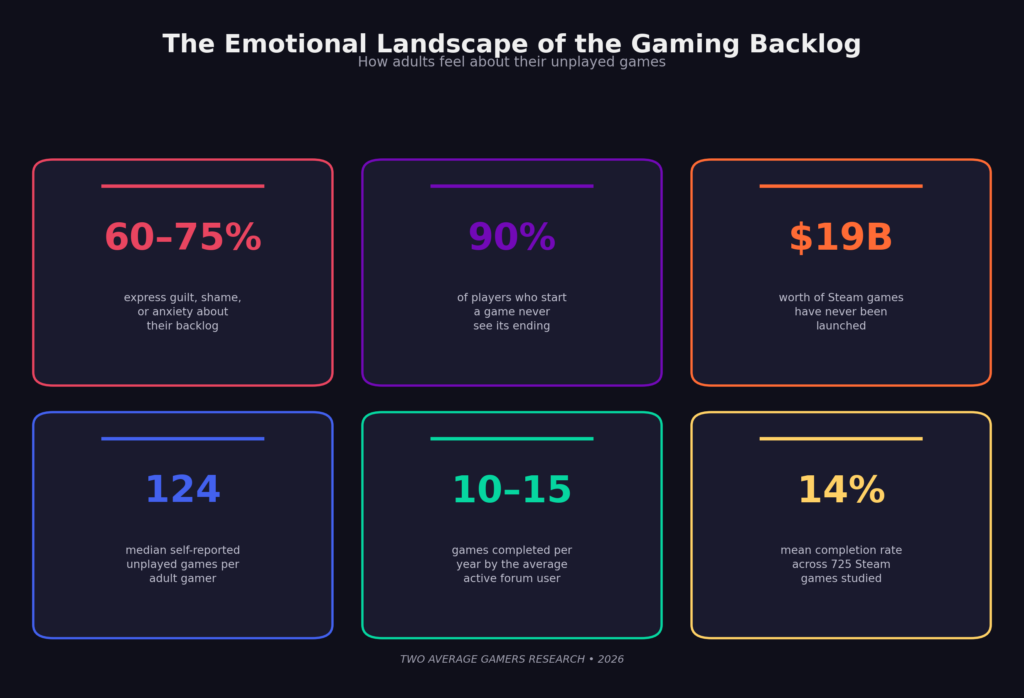
Roughly 60-75% of backlog discussions contain guilt or anxiety language
The emotional data is perhaps the most striking finding. In backlog-specific threads across all platforms, an estimated 60-75% of comments contain explicit guilt, shame, anxiety, or overwhelm language. The term “pile of shame”, which embeds guilt directly into the vocabulary, is universally understood across every gaming community without explanation, suggesting the emotional framework is deeply embedded in gaming culture itself.
The most common emotional expressions cluster into distinct categories. Financial guilt (“I’ve wasted hundreds on games I’ll never play”) appears most frequently, followed by choice paralysis (“I have 200 games and nothing to play”), obligation anxiety (“I should be playing X instead of Y”), and FOMO (“everyone’s discussing this game and I haven’t started it”). A TheGamer essay about backlog paralysis and depression captured the phenomenon: “I received a text message asking if I had started Red Dead Redemption yet, one of the 100 or so games in my backlog, and Scarlet Nexus has remained untouched as I finished my night watching TV, feeling too overwhelmed to move.”
The tension between gaming as obligation versus joy generates some of the richest discussions. Users describe gaming with words borrowed from work: “chore,” “homework,” “job,” “task list,” “obligation.” A Cult Classic blog post crystallized it: “So many of the games on this list are ‘shoulds.’ A much smaller number of them are ‘wants.’ In my attempts at trying to avoid missing out on the games I feel like I should play, I’m finding myself missing out on the games that I actually want to play.” An academic paper by Rainforest Scully-Blaker at UC Irvine, presented at AoIR in 2021, offered the sharpest framing: players experience “an obligation to relax”, a paradox where leisure becomes labor. The paper found that the very concept of “backlog” is borrowed from workplace productivity language, revealing how play has been colonized by the logic of task completion.
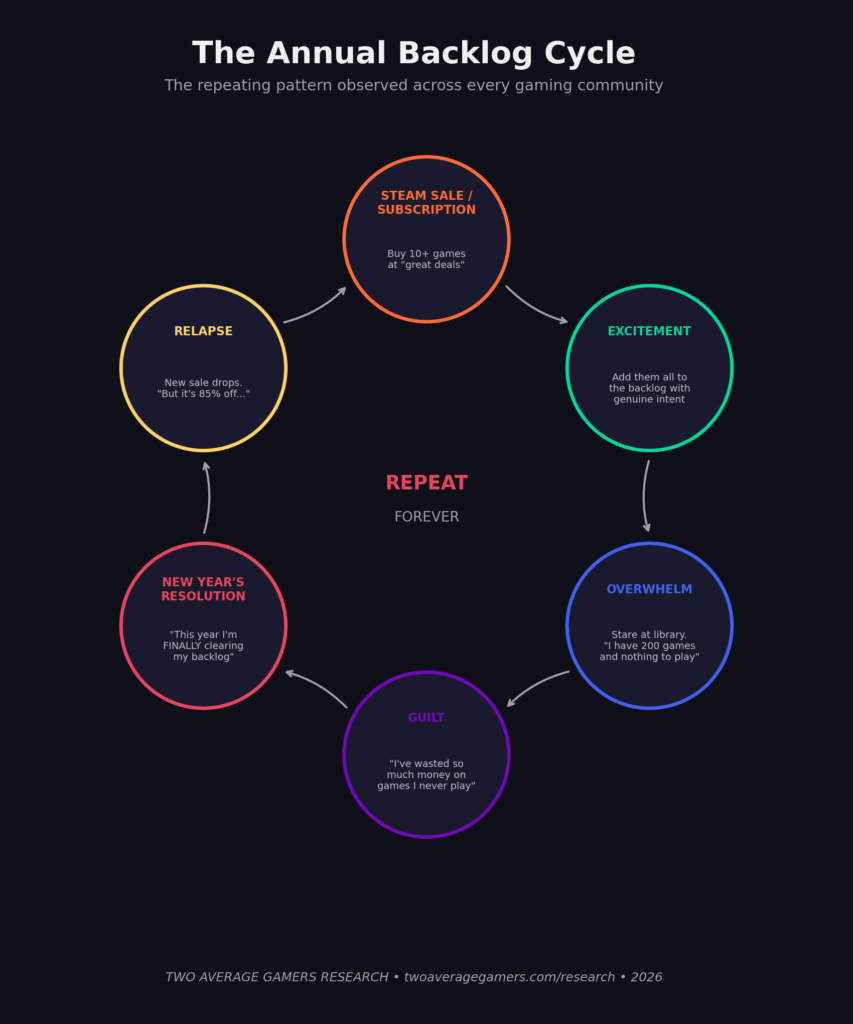
The most-upvoted post in r/patientgamers history reportedly carries the title: “My thoughts after finally clearing my backlog: This was a huge f*cking mistake”, suggesting that even achieving the goal doesn’t deliver the expected relief. The emotional arc across all forums follows a consistent five-stage pattern: initial enthusiasm buying → growing guilt → attempted “clearing” phase → acceptance and reframing as “library” → peace with never finishing everything.
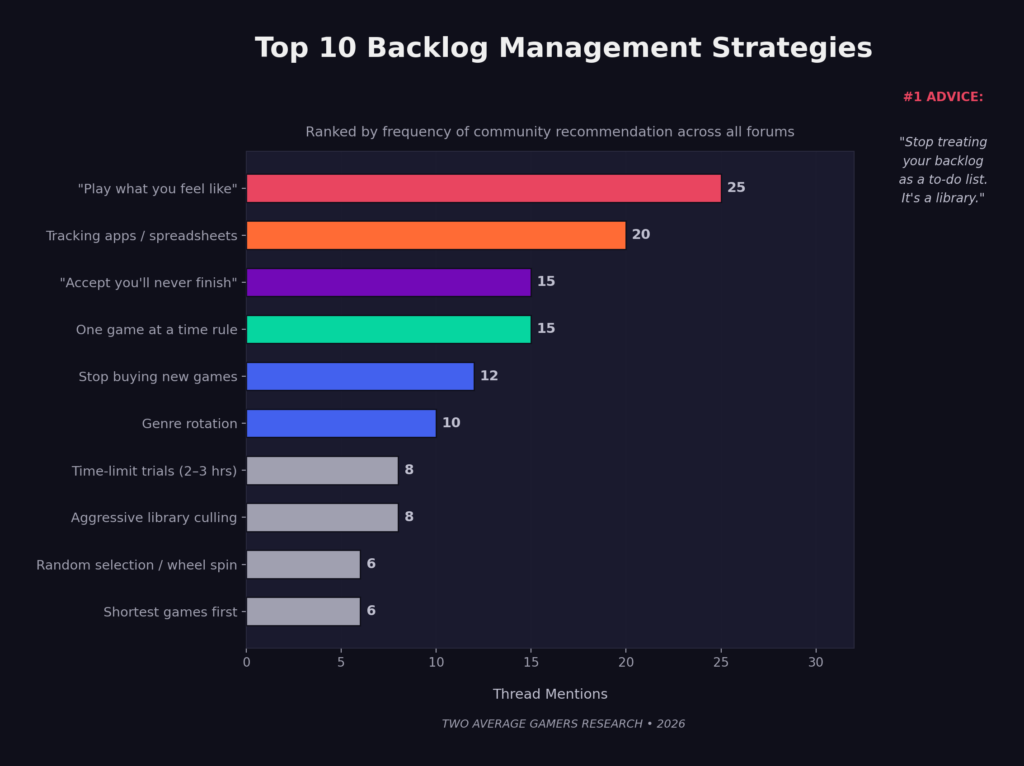
“Play what you feel like” wins, but spreadsheets die within weeks
The most commonly recommended backlog strategy, appearing in 25+ threads across all platforms, is deceptively simple: “Stop treating your backlog as a to-do list. It’s a library, not an obligation. Play what you feel like.” Variations appear everywhere, “stop caring,” “follow your mood,” “there is no backlog, only a collection, a library, treasure”, and users who adopt this mindset consistently report reduced stress and more gaming enjoyment.
The full strategy rankings by frequency of community recommendation:
- Mood-based selection (~25+ mentions), overwhelmingly the top advice
- Tracking apps and spreadsheets (~20+ mentions), Backloggd (650K+ users by end 2025), HowLongToBeat, Google Sheets, and Notion templates are popular, but the dirty secret is most tracking systems are abandoned within weeks (“the spreadsheet became another thing on my to-do list”)
- “Accept you’ll never finish them all” and reframe as library (~15+ mentions)
- One game at a time rule (~15+ mentions), effective for disciplined users, too rigid for others
- Buying bans / stop purchasing (~12+ mentions), universally acknowledged as correct, rarely sustained
- Genre rotation (~10+ mentions), alternating between long RPGs and short indie games prevents burnout
- Time-limit trials (~8 mentions), giving a game 2-3 hours to hook you, then dropping guilt-free if it doesn’t
- Aggressive culling (~8 mentions), deleting or categorizing games you’ll never play (one user created a Steam category called “DDL”, Did Not Like)
- Random selection tools (~6 mentions), wheel spinners and RNG pickers, with the notable insight that if you’re disappointed by what randomization selects, that disappointment reveals what you actually want to play
- Shortest games first (~6 mentions), good for quick wins, but leaves the longest games permanently untouched
The #1 trigger for starting a backlog game is mood or genre craving (“I suddenly had the urge to play an immersive-sim, so I started Dishonored”), followed by needing a palette cleanser after a long game. The #1 trigger for abandoning a game is simply boredom, followed by the game feeling too long, a difficulty spike, and the arrival of a shiny new release. The community largely agrees: dropping games guilt-free is the single most liberating skill an adult gamer can develop.
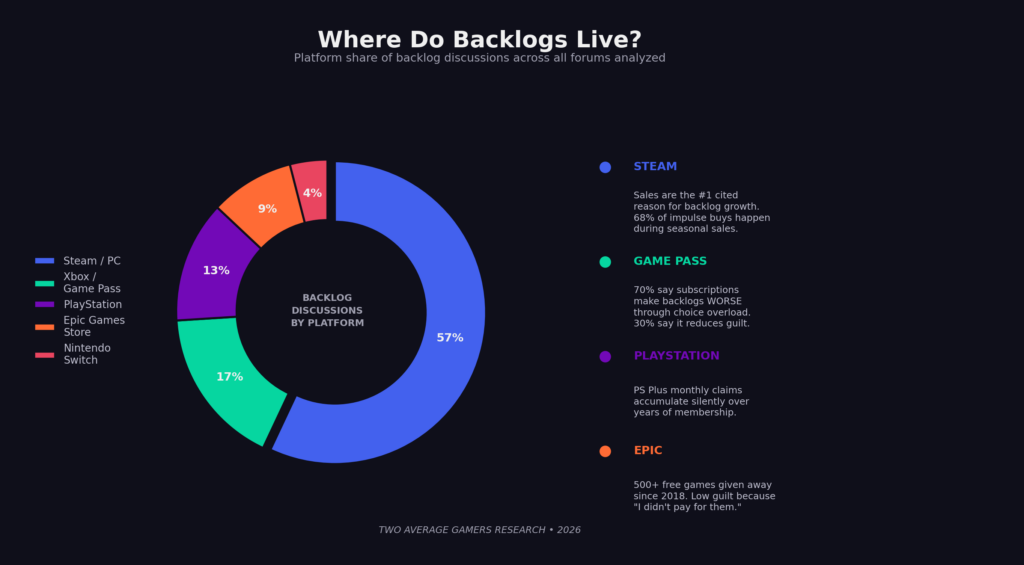
Steam dominates backlog culture, and sales are the primary culprit
Steam accounts for approximately 55-60% of all backlog discussions across every platform examined, making it the undisputed center of backlog culture. The combination of deep discounts, bundle culture, and tools like SteamDB Calculator that make library waste quantifiable has created a unique ecosystem of accumulation and guilt. The Steam Summer Sale and Winter Sale are the two most frequently cited events driving impulse purchases, with one widely cited figure suggesting 68% of impulse game purchases happen during seasonal sales.
Xbox and Game Pass represent 15-20% of backlog discussions, but from a distinct angle: subscription overwhelm rather than purchase regret. The NeoGAF Game Pass thread was literally subtitled “Our Backlogs Are Doomed.” A roughly 70-30 split emerges in community sentiment: the majority view is that Game Pass makes backlogs worse through choice overload and “subscription paralysis,” while a minority argues it liberates players from sunk-cost guilt (“I try a game for an hour and don’t feel guilty about uninstalling it. Had I bought it, I would’ve felt obligated to continue”). The October 2025 price hike from $19.99 to $29.99/month triggered mass cancellations that crashed Microsoft’s website, with many users explicitly framing it as an opportunity to finally tackle their existing libraries.
PlayStation captures 10-15% of discussions, primarily around PS Plus monthly additions accumulating over years. Epic Games Store, despite generating enormous libraries through its weekly giveaway program (500+ free games since 2018), accounts for only 8-10% of discussions, likely because the zero-cost nature reduces financial guilt. As one NeoGAF user perfectly captured: “I barely play the games on my Steam backlog and I paid for those.” Nintendo Switch is notably underrepresented at just 2-3%, likely because Nintendo’s premium pricing and rare discounts naturally constrain library sizes.
The financial data is sobering. Individual SteamDB Calculator results shared in forums show accounts valued at $1,500-$4,500+ at full retail, with 46-98% unplayed rates. Users consistently note that actual spending is 30-50% of the listed value due to sales and bundles, but even at half price, the accumulated waste is significant. The common cycle: buy during a Steam sale with genuine intent to play → lose interest before installing → feel guilty during the next sale → buy more games to compensate for the guilt of not playing the last batch.
Backlogs are growing, and the structural forces behind them aren’t stopping
Every trend indicator points in the same direction: backlogs are growing and will continue to grow. This conclusion is virtually unanimous across communities. Steam alone saw 18,626 new releases in 2024, requiring an estimated 335,000+ hours to complete, or roughly 38 years of nonstop play. Revenue hit $10.8 billion in 2024, up 24% year-over-year, meaning more games are being purchased even as existing backlogs swell.
The structural forces driving growth are mutually reinforcing. Digital distribution eliminates the friction of physical purchase. Subscription services add games automatically. Free giveaways create “phantom backlogs” of hundreds of unclaimed titles. Rising game lengths, driven by open-world design and the “dollar per hour” metric, mean each individual game requires more time to complete. And the fundamental adult gamer paradox persists: disposable income increases while available time decreases, creating a perfect recipe for accumulation.
The annual New Year’s resolution cycle provides the clearest evidence that the problem is intractable at the individual level. Every January, forums fill with threads pledging to “buy less, play more” and “finally clear the backlog.” A Vice headline from January 2025 says it all: “2025 Is Going To Be the Year I Clear Out Some of My Backlog. I Say as I Purchase Three New Steam Games.” Success rates on these resolutions are described across communities as “mixed-to-low.” The most successful backlog reducers tend to use three specific tools: numerical tracking via Backloggd or spreadsheets, community accountability through annual completion threads, and the willingness to aggressively drop games that aren’t clicking.
The active adult gamer who participates in forums manages to complete roughly 10-15 games per year, but the broader Steam population tells a darker story. A 2019 study of 725 Steam games found only a 14% mean completion rate (10% median), and former Activision production contractor Keith Fuller estimated that 90% of players who start a game never see its ending. The gap between games purchased and games completed is not a bug in the system. It’s the system working exactly as designed by an industry optimized for sales volume over play completion.
The backlog isn’t a problem to solve, it’s a condition to manage
The data reveals something the gaming industry doesn’t often acknowledge: the dominant emotional experience of adult gaming is not joy or excitement but a low-grade anxiety about all the things you’re not playing. Two-thirds of backlog discussion participants express some form of guilt, and the universal vocabulary, “pile of shame,” “backlog anxiety,” “gaming guilt”, tells us this isn’t individual failure but a shared cultural condition produced by specific market forces: aggressive discounting, subscription bundling, free giveaway programs, and an industry that releases more quality content annually than any human could consume in a lifetime.
The community has collectively arrived at a wisdom that runs counter to productivity culture: the goal is not to clear the backlog. It’s to stop having a backlog at all. Not by playing everything, but by abandoning the concept. The most psychologically healthy gamers in these discussions don’t track completion percentages or maintain spreadsheets. They treat their libraries the way you’d treat a bookshelf or a streaming catalog: as options available when the mood strikes, not obligations awaiting fulfillment. “There is no backlog,” as one ResetEra user put it. “Only a collection. A library. Treasure.” The $19 billion in unplayed Steam games isn’t wasted money. It’s the price of admission to a hobby that, for all its anxiety, still serves as the primary escape, comfort, and creative outlet for millions of adults navigating the competing demands of careers, families, and the finite hours of a human life.