
Is Valorant Toxic? An Honest Answer Backed by Data (2026)
You jumped in, you played a few ranked games, and at some point your voice chat turned into something you wouldn’t want your kids to hear. Or you’re thinking about playing and you’ve seen the clips. Either way you’re here asking the same question everyone asks before committing serious time to Valorant: is it actually as bad as people say?
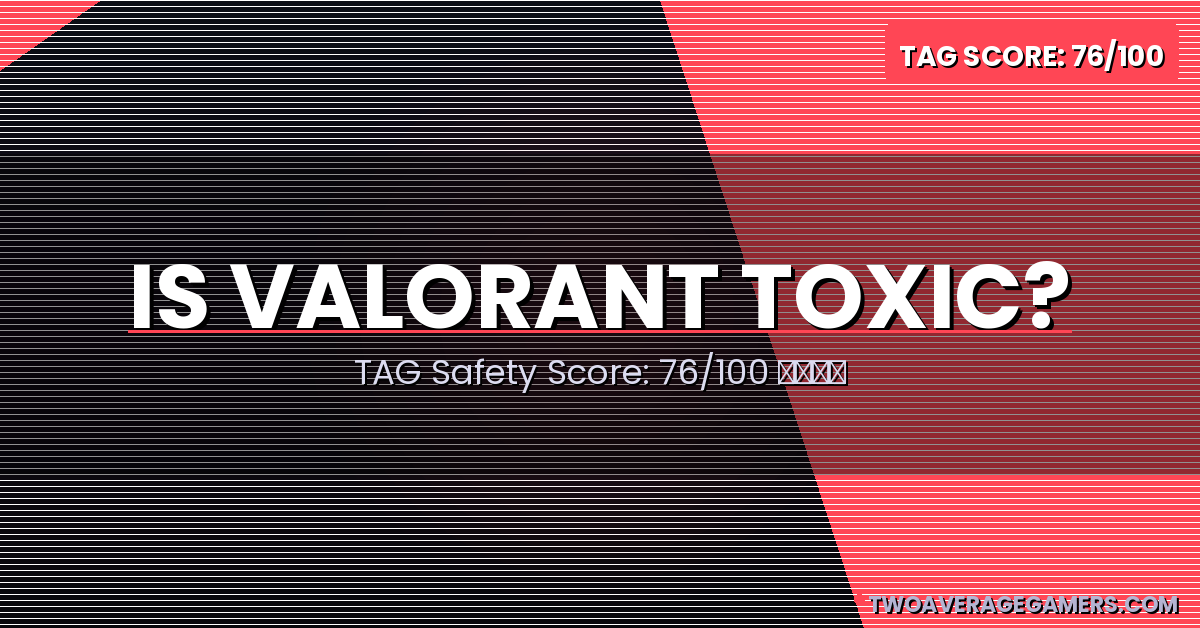
Short answer: yes. Longer answer: it’s particularly bad in a way that’s very controllable, and the infrastructure Riot has built around it is genuinely good, which is exactly why Valorant scores 76/100 (★★★★) on the TAG Community Safety Score despite having one of the worst raw harassment rates in gaming.
That gap between “high harassment rate” and “strong safety score” is the whole story. Let’s get into it.
Worst-in-Class Harassment Numbers, and Voice Chat Is Ground Zero
Valorant holds a grim distinction: the Anti-Defamation League’s survey data recorded 79% of Valorant players receiving some form of harassment, the highest rate of any individual game in the study. Dota 2 came close at 78%. Most games were in the 50-65% range.
That 79% number is from 2021. The 2024 ADL follow-up experiment, where researchers played using identifiably diverse usernames, found Valorant produced only 36% positive interactions, compared to 69% in Overwatch 2, 55% in CS2, and 40% in Fortnite. For context, that’s the lowest positive interaction rate across all games tested.
A 2025 academic study by Görlich, Wagner, and Breuer published in Lecture Notes in Computer Science found that female players are harassed in every seventh Valorant game, ranging from unsolicited comments about gender to explicit threats. The same research covering both Valorant and Overwatch voice chats found profanity in 80.8% of sessions, sexual comments in 14.2%, and general verbal abuse in 25.8%.
And then there’s this, which is the most damning stat Riot has ever published about their own game: in their own 2022 behavioral systems dev diary, they admitted that despite increasing enforcement actions, “the frequency with which players encounter harassment in our game hasn’t meaningfully gone down.”
Riot’s own enforcement was working, banning more people, processing more reports, and the experience on the ground wasn’t improving. That takes guts to publish, and it tells you how deep-rooted the problem is.
The good news: Riot then spent 2023, 2024, and 2025 accelerating their response harder than almost any studio in gaming. And the mode and settings you choose matter enormously.
Why Valorant Gets This Bad
Valorant‘s toxicity isn’t random. There are structural reasons this game breeds it in ways that other competitive shooters don’t to the same degree.
Voice chat is the primary vector. Unlike League of Legends, where most toxicity flows through text chat, Valorant built in full team voice from day one, it’s designed to be a communication-heavy game where callouts matter. That means players are in each other’s ears every round, and the voice channel is where the worst abuse lives. Slurs, sexual harassment, threats, these are voice-chat phenomena in Valorant far more than text-chat ones.
The round structure creates compounding frustration. Each round feeds directly into the next in terms of economy. A bad round doesn’t just mean you lost that round, it means you’re starting the next one with less money, which affects your buy, which affects your chances the round after. A single early mistake can cascade, and players who understand this get increasingly frustrated with teammates who caused it.
Smurfing is a documented toxicity amplifier. Players running secondary accounts at artificially low ranks create lopsided matches, then often demean players who can’t keep up with someone who isn’t actually at that skill level. Academic research pinpoints smurfing as a major hostility driver in Valorant, particularly against players from minority groups who get mocked for “playing badly” in matches where they’re already at a structural disadvantage.
The identity targeting problem is particularly acute here. The ADL’s username experiment found that in Valorant, players with diverse identity usernames, identifiably female, racially coded, LGBTQ-associated, received measurably more harassment than neutral usernames playing at the exact same level. The targeting isn’t random. People are scanning for identity signals.
What Riot Has Actually Built
Here’s why Valorant scores 76/100 despite the raw harassment numbers. Riot has built the most technically sophisticated voice moderation system in consumer gaming, and they’ve kept expanding it.
Voice recording and evaluation launched in July 2022, starting with North America and English-only. When a player is reported for voice-chat abuse, the relevant audio is stored, analyzed against behavioral policies, and actioned if a violation is found. Data is deleted when no longer needed for the review. As of the January 2025 update, voice evaluation in English has expanded to every country where Valorant is available outside Korea. Spanish language support was next in development pipeline.
This matters because voice abuse had been effectively unenforceable before this. Every major multiplayer game logs text chat, voice was a free pass. Valorant was the first major competitive game to close that gap.
Over 500,000 manual warnings and bans were issued in 2024 alone for toxic behavior. Executive producer Anna Donlon publicly acknowledged in May 2024 that Riot “needs to do better” on harassment, and then backed it with actual system changes and stricter punishment escalation throughout the rest of that year.
Vanguard handles anti-cheat at the kernel level with hardware fingerprinting. Cheaters and banned players can’t just make new accounts, the ban follows the hardware. Combined with Riot’s cross-game penalty linking, a ban in Valorant carries consequences across Riot’s whole ecosystem.
Zero-tolerance offenses go straight to immediate action, no graduated warnings. The comms restriction system creates an internal “comms rating” per player, so repeat offenders reach harsh penalties faster than first-time offenders.
The honest caveat: Riot themselves acknowledged that all these enforcement numbers don’t necessarily mean the player experience is improving. They’re catching more people. Whether that translates to fewer incidents for you personally depends a lot on what modes you’re playing and how you configure your settings.
For a breakdown of exactly how to file a Valorant report that actually gets reviewed, check our complete guide to reporting toxic players.
Mode-by-Mode: Where Toxicity Lives in Valorant
Not all Valorant is equally rough. Here’s the actual map:
Competitive ranked is where the worst of it lives. Stakes are highest, voice communication is most active, players are most invested, and the round structure creates the most blame-assignment opportunities. If you’ve had a bad experience with Valorant toxicity, it was almost certainly here.
Unrated is noticeably calmer, no rank on the line, mixed intentions, players who are experimenting with agents rather than grinding. Still can have toxic lobbies, but the frequency drops sharply without the LP pressure.
Swift Play (first team to 5 rounds) is the sweet spot for adult gamers who want actual Valorant gameplay without a 40-minute commitment or ranked stakes. Shorter matches mean less time for frustration to compound. The playerbase tends to be more casual. This is the mode most underused by people who want Valorant without the headache.
Spike Rush (6-8 minutes, randomized weapons, first to 4 rounds) is genuinely casual. Random weapon assignments remove gear envy and much of the strategic complexity that creates blame moments. Queue times are near-instant. It’s not ranked Valorant, but it’s Valorant-flavored fun with minimal toxicity risk.
Deathmatch has no teams. You’re literally just practicing aim in a free-for-all. The toxicity risk is near-zero by design.
The gate for ranked is worth knowing: you need 20 completed unrated matches before competitive becomes available. That’s Riot forcing a calibration period, it’s also inadvertently giving new players 20 games to see what they’re getting into before committing to ranked.
How to Play Valorant Without Losing Your Mind
The data is clear that you can cut your exposure dramatically through settings and habits. These are the ones that actually work.
Mute voice chat by default. Go to Settings → Audio → set Voice Chat to Off, or just spam the mute button in agent select on anyone who immediately starts talking nonsense. You lose some callout value. You gain your sanity. For adult gamers who aren’t grinding Immortal, the callouts aren’t worth what the voice channel costs you in bad sessions. Use text pings, the ping wheel is genuinely excellent in Valorant and communicates most of what you need.
Use “Party Voice Only.” This setting restricts your voice chat to only people in your party, while still letting you hear in-game audio and use the ping system. You get the coordination benefits of playing with people you trust without opening your ears to five strangers.
Play with a premade. Two or three people you know cuts toxicity risk in half. A full five-stack eliminates it almost entirely. Adult Valorant communities exist for exactly this: r/VALORANT’s LFG thread skews older than you’d expect, and Discord communities like Valorant Community (the official server) have dedicated adult/casual channels.
Match mode to energy. Ranked after a stressful day is a trap every time. Swift Play or Spike Rush after a rough day at work. Ranked when you have bandwidth for it. This sounds obvious and yet most people ignore it and then wonder why they’re tilted after ten minutes.
If you hear something report-worthy, use the in-game report immediately. With voice recording now active for English speakers worldwide, voice reports actually go somewhere. The post-match report screen is your best tool, use it every time something crosses a line, not just when it’s extreme.
Is Valorant Worth Playing?
For pure gameplay quality, Valorant is one of the best competitive shooters ever made. The agent design, the tactical depth, the map-making, it’s a genuinely excellent game. The toxicity problem doesn’t change that.
For adult gamers who want a competitive shooter and are willing to mute voice by default, play with a group, and stay out of ranked when they’re tired, Valorant is absolutely worth playing. The 76/100 TAG score reflects exactly this: strong systems, real enforcement, real transparency, and a studio that at least acknowledges when the numbers aren’t improving.
If you want a competitive shooter with less toxicity overhead, Apex Legends in trios or Deep Rock Galactic give you the shooter experience with a fraction of the voice-chat war stories. See our full rundown of the least toxic online games for the full comparison.
But if Valorant is the game you want to play? Go in with voice muted, friends in your party, and Swift Play as your default when ranked feels like too much. The game is better than its reputation in those conditions.
Had a particularly good or bad experience with Valorant’s toxicity? Drop it in the comments or find me in the TAG Discord. We track player experiences across every major game as part of the Community Safety Score research.
About the Author: Fred is the founder of Two Average Gamers, a gaming site for adults who play games to unwind, not to get yelled at by strangers. He has played exactly zero ranked Valorant matches with voice chat enabled in the last 18 months and has no regrets.