
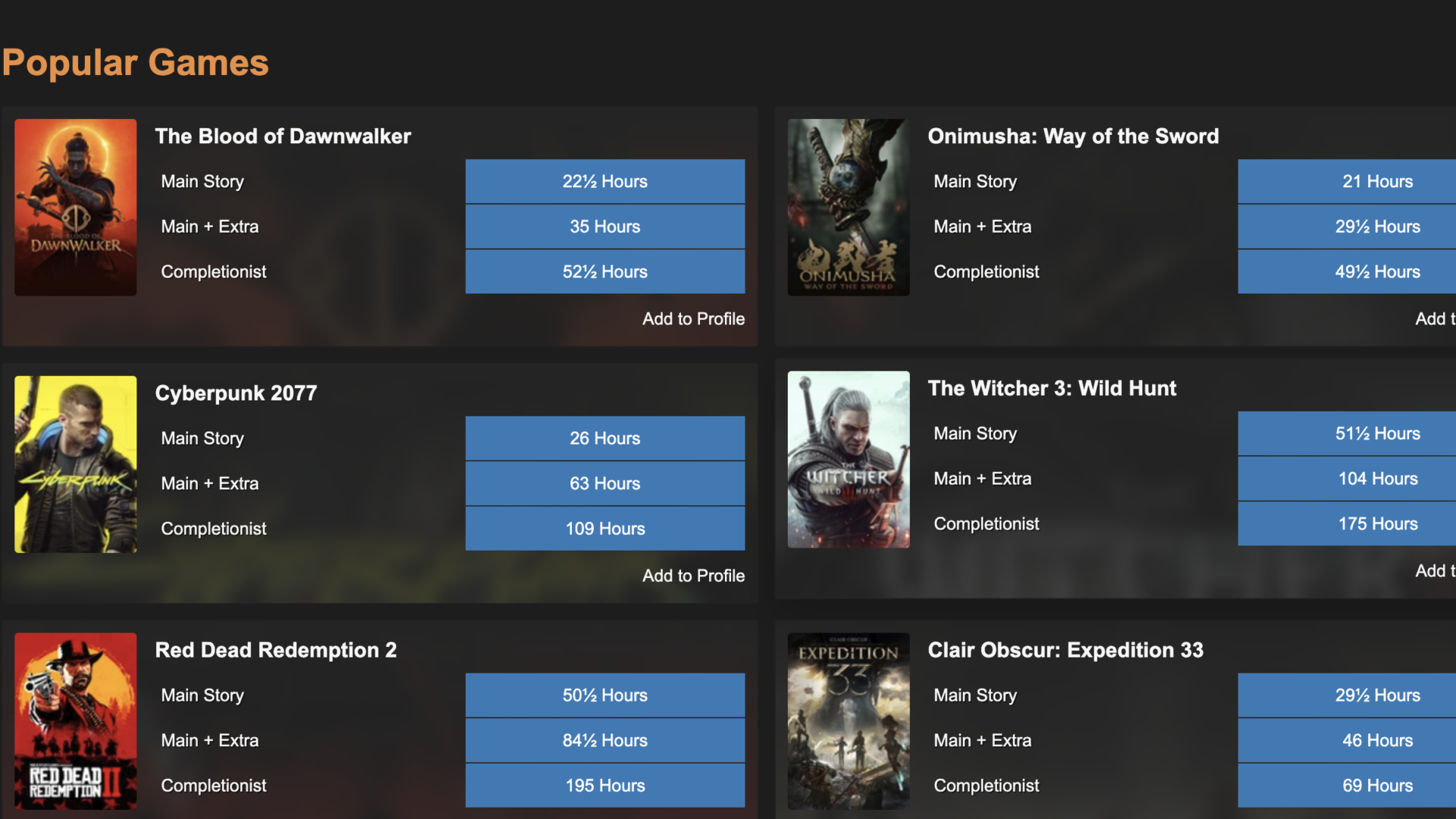

Yes, HowLongToBeat is still worth using. No, it’s not a backlog tracker and you shouldn’t try to make it one. That’s the whole review in two sentences: it answers exactly one question extremely well, costs nothing, and gets misused constantly by people trying to make it do a second job it was never built for.
If you’ve landed here typing “is HowLongToBeat accurate,” the short version is: usually, on anything popular, and increasingly not the deeper you get into niche titles. I’ll walk through why, and how to actually use the site so it earns its place as a bookmark instead of becoming another half-abandoned account.
What HowLongToBeat Actually Does
The core of the site is simple. For most games it lists four numbers: Main Story, Main + Extras, Completionist, and All Styles, which is the blended figure you’ll also see surfaced inside Microsoft’s Xbox app on Game Pass pages. Every one of those numbers comes from players who finished the game and manually submitted their elapsed time, category, and platform. There’s no automated tracking pulling this from Steam’s playtime counter or a console’s activity log. A human typed it in.
That’s the entire mechanism, and it’s been the entire mechanism since the site launched in 2011. No account is required to search or read a game’s page. You type a title, you get a number, you close the tab. For the specific job of “should I start this tonight or is this a weekend-eating commitment,” nothing else does it faster.
Where the Numbers Are Solid, and Where They Fall Apart
Accuracy tracks directly with submission volume, and that’s worth understanding before you trust a number blindly. A major release with thousands of completions behind it produces a tight, reliable average. An obscure title can be built off as few as four or five submissions, and at that sample size one completionist speedrunner or one person who left the game idle overnight can swing the number hard in either direction.
There’s a theory floating around gaming forums that HowLongToBeat’s contributor base skews more dedicated and more completionist than the average player, which would mean the numbers run a little long across the board. It’s a reasonable guess and it’s plausible, but I haven’t found a formal study that actually confirms it, so I’ll flag it as a theory rather than a fact.
Two other things genuinely break the model. Live-service and multiplayer games don’t have a coherent “completion” state, so any number attached to something like a season-based shooter or an always-online game should be read skeptically, if it exists at all. And remasters or re-releases sometimes fragment submissions across multiple separate entries on the site, which thins out the sample for each version individually.
No outside party has run a formal accuracy audit against ground truth, as far as I can tell. The dataset does get used in academic and hobbyist work, including at least one published research paper and various Kaggle scrapes, which suggests people trust it as a reference point. Being widely used isn’t the same as being independently verified, and it’s fair to hold both of those thoughts at once.
The Price Is Right, Literally
There’s no premium tier. I looked for one specifically because “surely there’s a paid version with more data” is the kind of thing that exists everywhere else in this space, and it doesn’t here. The site runs on ads and that’s it. Every category number, every list feature, everything I’m about to describe in the next section, all of it is free with no upsell waiting behind a paywall.
That matters more than it sounds like on paper, because HowLongToBeat also has a real Steam library import, and it’s free. A lot of people don’t know this exists. It’s been available since at least 2021 and it pulls your owned Steam games straight into the site. There’s a GOG integration too. Compare that to most dedicated trackers, where an automated library import is exactly the kind of feature that sits behind a subscription, and giving it away for free is a genuinely good look for a site that could easily charge for it.
The gap is on the other side: there’s no native Xbox or PlayStation import. If your library lives on console, you’re adding games manually, same as everyone else who isn’t on Steam or GOG.
The Account Features Exist. Use Them Sparingly
Create a free account and you get status lists (Backlog, Currently Playing, Beaten, Retired, Wishlist, and custom lists), a personal completion log with notes attached to each entry, and stats comparing your own pace against the community average. On paper that’s a full tracking suite sitting right next to the lookup tool.
In practice, community sentiment on this is consistent: the tracking side feels bolted on. A widely-cited ResetEra thread from 2025 described the UI as “inelegant” next to something like Backloggd, which was built from the ground up to be a library and a feed, not a lookup tool with lists tacked on afterward. I agree with that read. The core product here is the number on the game page. Everything account-related is a secondary feature that happens to exist, not the reason to visit.
One thing I want to be straight about rather than guess at: the site ran a 2025 sitewide Year in Review recap covering most-played titles and notable “retirements,” and it got real attention on forums like ResetEra and Famiboards. Whether that recap includes a personalized, per-user card the way some trackers do, or whether it’s purely a sitewide aggregate everyone sees the same version of, I genuinely couldn’t confirm either way. I’d rather tell you that’s unresolved than state it confidently and be wrong.
The Interface Hasn’t Caught Up to 2026
I can’t point to a specific redesign date because I couldn’t confirm one happened at all in the last couple of years, which is itself the point. The site looks and feels largely unchanged in spirit for over a decade: dense, utilitarian, ad-heavy, clearly built by people optimizing for function over form. HowLongToBeat was acquired by Ziff Davis back in 2021 and now sits inside IGN Entertainment alongside properties like Humble Bundle and MapGenie. The visible changes since that acquisition have been distribution deals, like the Xbox app integration and a Heroic Games Launcher tie-in, not a product overhaul.
Here’s the thing though: it’s fast, and search is prominent and responsive. Game pages load quick and put the numbers front and center instead of burying them under a redesign’s worth of cards and hero images. Dated doesn’t mean bad here. It means nobody’s spent a design budget on it in a while, and the tool still does its one job without friction.
How a Busy Adult Should Actually Use This
The mistake I see people make is trying to run HowLongToBeat as their backlog system: adding every game they own to a status list, updating it as they play, checking back in for the stats. It can technically do that, and it’ll feel clunky the whole time, because that’s not what the tool was built to be good at.
The better use is a pre-commitment check, not an ongoing log. Before you start something new, or before you decide whether tonight’s the night you finally crack open that game that’s been sitting in your library for eight months, pull up its page and look at the Main Story and Main + Extras numbers. That’s it. That’s the entire workflow. You’re not building a permanent record inside the site, you’re using it as a calculator you consult once per decision.
If you actually want a running record of what you’ve played, what’s still in the backlog, and some sense of whether your backlog is a manageable size or a slow-motion problem, that’s a different category of tool entirely, and it’s fine to want both. A dedicated tracker like SavePoint exists specifically for the “what’s my backlog actually costing me” side of this that HowLongToBeat was never trying to solve. Use HowLongToBeat for the gut check, use something built for tracking for the tracking.
Who Should Skip It
Almost nobody, honestly. It costs nothing, requires no account for the core function, and answers a question worth answering before you sink a weekend into something. If you play almost exclusively live-service or multiplayer games where “completion” doesn’t really apply, the numbers will be thin or missing for a lot of your library, so temper your expectations there specifically. Everyone else has no real reason not to keep this bookmarked.
One Bookmark, Not One Account
I’ll use HowLongToBeat again the next time I’m deciding whether a game fits into the two or three hours I actually have free this week. I won’t be logging my backlog there, and I don’t think most people should either. It’s a free, fast, crowd-sourced answer to a single specific question, and it’s stayed reliably good at that one job for over a decade without needing to become anything else. Bookmark it, use it before you commit, and keep your actual backlog tracking somewhere built for that job.
If you want to see how HowLongToBeat stacks up against a purpose-built tracker rather than just a lookup tool, I broke that down in HowLongToBeat vs Backloggd: Why I Use Both, Not Just One. And if you’re curious how it compares against the other six tools I tested for logging an actual gaming library, that’s in Letterboxd for Games? We Tested 7. Here’s the One.
TAG Pro launches December 1: ad-free gaming media for people who play on adult-mode hours, not teenager-mode hours. Founding seats are open now at twoaveragegamers.com/founding.
Got a backlog you want to talk through, or a tracker I should test next? Come argue about it in the TAG Discord.
📌 Save HowLongToBeat Review: Still the Best Free Answer to ‘How Long Is This Game?’ to your backlog
Track every game you play, rate what's worth finishing, skip the overhyped ones.


